Halley’s Comet and the Orionid Meteor Shower
Halley’s Comet and the Orionid Meteor Shower
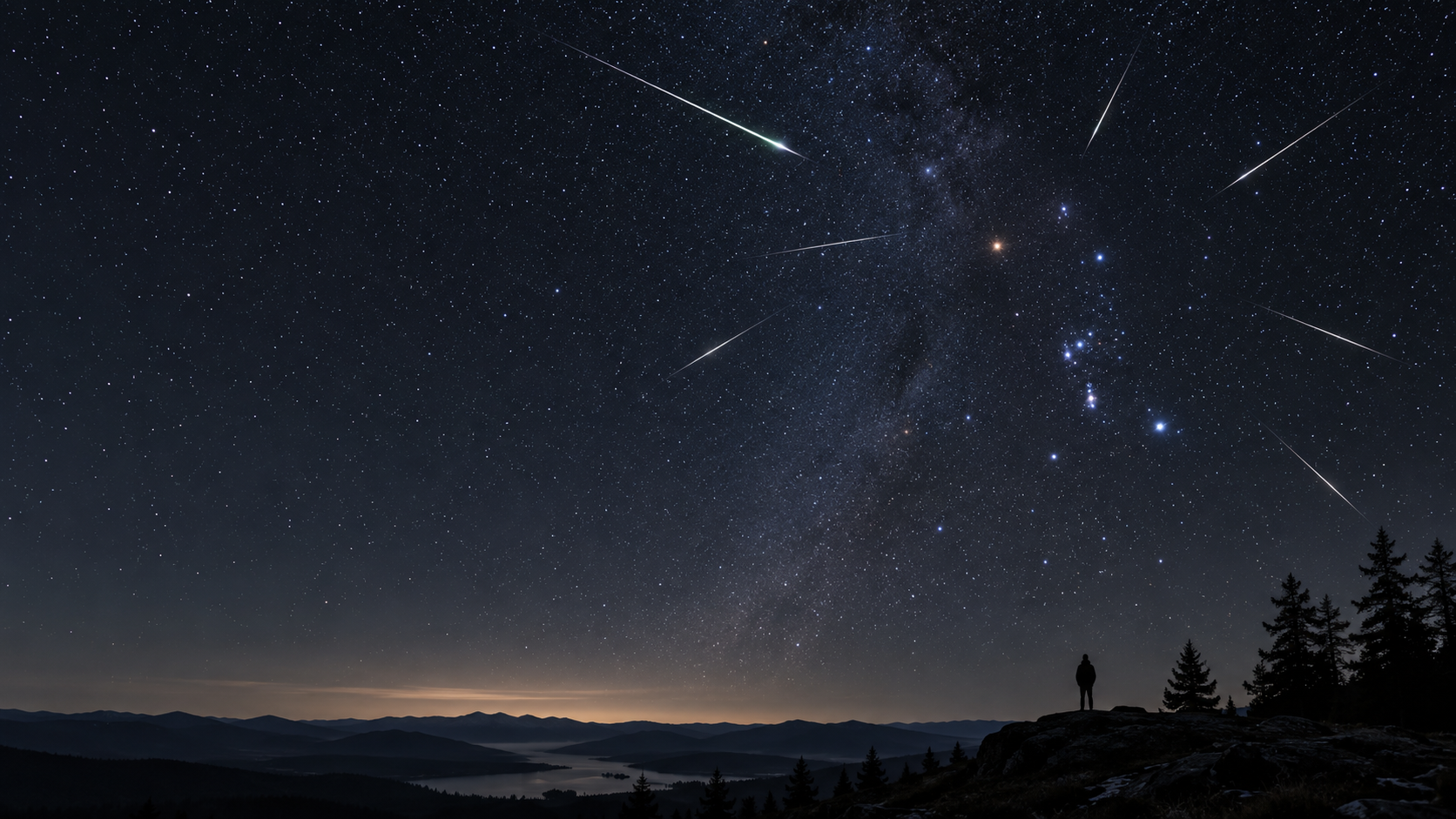
A remarkable night-sky image brings together two related celestial phenomena: distant Halley’s Comet and bright streaks from the Orionid meteor shower. The photograph creates the impression of a cosmic meeting, with the faint comet set against a sky crossed by flashes of light. In reality, the objects occupy very different environments and distances.
Halley’s Comet is a large icy body traveling through the Solar System. Orionid meteors are small particles entering Earth’s atmosphere at high speed. Their connection is not a close physical encounter captured in one frame. It is an orbital connection: debris released by Halley’s Comet produces the meteor shower when Earth passes through part of that debris stream.
The astrophoto turns that scientific relationship into a powerful visual story. It shows the comet as a distant, faint target while meteors appear as sharp, short-lived trails closer to Earth. It also demonstrates how astrophotography can reveal objects and details that are difficult to identify during ordinary stargazing.
What the Astrophoto Shows
Halley’s Comet as a Distant Target
Halley’s Comet may look surprisingly small in a wide-field image. Although it is one of astronomy’s best-known comets, it does not always appear as a bright, obvious object. Its visibility depends on its distance from the Sun and Earth, its activity level, viewing geometry, and the darkness of the observing site.
A long-exposure photograph collects far more light than the unaided eye can detect during a brief glance. The comet may therefore appear as a small, diffuse patch or faint point surrounded by subtle material. Its coma—the cloud of gas and dust around the nucleus—can be difficult to distinguish without careful focus, accurate framing, and image processing.
The composition creates a visual relationship between Halley’s Comet and the meteors, but it does not show that the comet is physically close to the meteor trails. A two-dimensional image compresses depth, allowing distant objects and nearby atmospheric events to appear beside one another.
Orionid Meteors Streak Across the Frame
Orionid meteors are brief flashes produced when small particles enter Earth’s atmosphere at high speed. Friction and compression heat the surrounding air, creating the luminous streak observers call a meteor. Most particles are tiny, but their speed allows them to produce visible trails across the sky.
In a photograph, a meteor usually appears as a narrow linear streak. Several trails in one frame or across a sequence can add motion and depth to an otherwise static landscape. The effect is especially striking when the streaks cross a field containing stars, constellations, or a faint comet.
Meteor trails should not be confused with these other features:
- A comet’s tail: Diffuse and shaped by sunlight and the solar wind.
- Satellite trails: Usually smooth, continuous lines with relatively uniform brightness.
- Aircraft lights: Trails that may contain regularly spaced bright points from navigation or strobe lights.
- Star trails: Arcs caused by Earth’s rotation during long exposures or by camera movement.
Strong meteor images often require a fixed camera, a wide field of view, a long series of exposures, and later selection or stacking. A single exposure may capture one meteor—or none at all.
Why the Image Matters Scientifically
The photograph is more than a scenic arrangement of stars and streaks. It places the parent comet and its atmospheric debris in the same broader scientific story.
Halley’s Comet releases dust and small particles as it travels through the inner Solar System. Some of that material remains distributed along or near its orbit. Earth encounters part of the debris stream each year, producing the Orionid meteor shower.
The image connects a long-lived Solar System object with flashes that last only fractions of a second. Photography also helps reveal faint astronomical targets. A camera sensor can accumulate light in a way the human eye cannot, allowing a processed image to show a dim comet, faint stars, and multiple meteor trails that might be difficult to recognize during casual observation.
The Connection Between Halley’s Comet and the Orionids
Halley’s Comet Leaves Debris Along Its Orbit
Comets are mixtures of ice, dust, and rocky material. When a comet approaches the Sun, solar heating causes some of its ice to vaporize. Gas escaping from the nucleus carries dust and small particles into space.
Many of those particles remain spread along the comet’s path around the Sun. Over time, debris becomes distributed along sections of the comet’s orbit. The particles can remain in space for long periods before Earth encounters them.
Not every Orionid particle was released during Halley’s most recent visit. The debris stream reflects material shed over multiple passages and altered by gravitational forces, solar radiation, and collisions. Halley’s Comet is a periodic comet with an orbital period of roughly 76 years, and its repeated returns have helped build the stream associated with the Orionids. NASA
Earth’s Passage Creates the Orionids
The meteor shower follows a simple sequence:
- Halley’s Comet releases dust and small particles during its journeys around the Sun.
- Some of that debris remains along or near the comet’s orbital path.
- Earth moves through part of the debris stream during its annual orbit.
- Particles enter Earth’s atmosphere at high speed.
- The particles heat the surrounding air and create visible meteor streaks.
The meteors appear to originate from a point in the constellation Orion. This point, called the radiant, gives the shower its name.
The radiant is a perspective effect. The particles do not emerge from Orion or travel outward from the constellation. Their atmospheric paths are broadly parallel, but from an observer’s position they appear to converge in the distance, much like parallel railway tracks appear to meet near the horizon.
Meteors can appear anywhere across the sky, although their trails may seem to point back toward the radiant. Observers who look only at Orion may miss longer trails elsewhere.
Orionid Meteors Are Not the Visible Comet
Halley’s Comet is a large icy nucleus surrounded by gas and dust. Orionid meteors are usually tiny particles—often no larger than grains of sand or small pebbles—that burn high above Earth’s surface.
The shower can remain visible when Halley’s Comet is faint, distant, or below the horizon. It depends on Earth’s position relative to the debris stream, not on the comet being near Earth at the same time.
This explains why a photograph can show a faint comet and bright meteors together without implying that they are nearby in space.
Why Halley’s Comet Is Difficult to See
A comet’s apparent brightness depends on its distance from the Sun and Earth, its activity, and the viewing angle. A comet’s coma or tail may also be directed toward or away from the observer.
Halley’s Comet can therefore be scientifically important without appearing bright in every image. A dark sky, precise focus, accurate tracking, and long exposures may be necessary to record it clearly.
Image stacking can improve the result. Multiple exposures are aligned and combined to strengthen the comet’s signal while reducing random noise. Tracking the stars or the comet can preserve faint detail, although each method produces a different appearance for the stars and foreground.
A comet’s tail does not simply trail behind it like smoke from a vehicle. The tail is shaped primarily by sunlight and the solar wind, so it generally points away from the Sun. A comet can have more than one tail, including a dust tail and an ion tail.
A straight, narrow line lasting only briefly is more likely to be a meteor trail than a comet tail. The comet’s surrounding material is diffuse and persistent, while an Orionid trail is a short-lived atmospheric event.
How to Watch the Orionids
Choose a Dark, Open Location
Observe away from streetlights, illuminated buildings, and bright signs. A wide, unobstructed view allows more meteors to appear in the field of vision.
Urban light pollution can wash out faint trails. Rural areas, dark-sky parks, beaches, high ground, and open fields may provide better conditions. Avoid looking directly at nearby lights and allow your eyes time to adapt. Dark adaptation can take 20 minutes or longer, and a bright phone screen can interrupt it.
Use a red-light setting or cover a flashlight with red film. Bring a reclining chair, warm clothing, water, and protection from dew or frost.
Observe During the Best Hours
The Orionids are often easier to see after midnight. At that time, the observer’s side of Earth is turning into the incoming debris stream, increasing the chance that particles enter the atmosphere above the local horizon.
The exact experience varies with location, weather, moonlight, and shower activity. No fixed meteor count is guaranteed. Check a current astronomy calendar for the predicted peak date, radiant altitude, moon phase, and local visibility.
Activity can extend across several nights, and clear skies on a nearby date may provide better viewing than a cloudy peak night.
Find the Radiant Without Looking Only at Orion
The radiant near Orion helps identify the shower, but it is not always the best place to look. Meteors near the radiant appear shorter because they move more directly toward the observer’s line of sight.
Instead, choose a broad area of dark sky roughly 45 degrees from the radiant. Keep the radiant above the horizon while allowing your view to include a large section of sky. This increases the chance of seeing longer trails.
Check Moonlight and Weather
Moonlight can reduce the number of visible faint meteors. Cloud cover, haze, humidity, and local light pollution can have an even greater effect than the predicted activity level.
Before observing, check the cloud forecast, moon phase and moonrise time, radiant altitude, local light pollution, and wind conditions. Prepare warm clothing and comfortable seating.
How to Photograph the Orionids
Camera and Lens Setup
Use a camera with manual exposure controls and RAW capture. A wide-angle lens covers more sky and increases the chance of recording meteors. A fast lens with a wide aperture collects more light, although fast lenses can produce edge distortion, coma, or soft stars.
Mount the camera on a sturdy tripod. Turn off image stabilization when the camera is fixed unless the lens manufacturer recommends otherwise. Use a remote shutter release or intervalometer to reduce vibration.
If the composition includes Halley’s Comet, careful framing matters. The comet may require a narrower or more deliberate composition than the meteor sequence. Use a star chart or astronomy application to locate it before beginning.
Recommended Starting Settings
Use these as starting points rather than universal rules:
- Manual focus set near infinity.
- Wide aperture.
- Exposure of several seconds.
- High but manageable ISO.
- RAW format.
- Manual white balance.
- Delayed shutter or remote release.
- Continuous or interval shooting.
Focus on a bright star using live view, then lock the focus. Test the exposure and inspect the stars at high magnification. Reduce the exposure or ISO if city lights make the sky too bright. Increase exposure time or ISO only if the sky remains dark and the stars are not overexposed.
A shorter exposure can preserve foreground detail and reduce star trailing. A longer exposure collects more light but may blur stars if the camera is not tracking.
Capture a Long Series
One frame may miss a meteor. A continuous sequence increases the chance of recording several trails. Keep the framing fixed if the goal is to combine meteor trails with a stable background.
Record the exposure time, ISO, lens, location, weather, and start and end times. These notes can help distinguish meteors from satellites and aircraft during review.
Avoid touching the tripod during the sequence. Check battery capacity and storage space beforehand. Cold conditions reduce battery life, so carry a spare battery and keep it warm until needed.
Combine the Comet and Meteors Transparently
The two subjects create different technical demands. Meteors are brief and bright, while Halley’s Comet is faint and requires accumulated light. A single exposure may not optimize both.
A practical workflow is:
- Capture a fixed-camera sequence for meteors.
- Photograph the comet separately using tracked or stacked exposures.
- Align the relevant images during processing.
- Combine the frames transparently if creating a composite.
- Label the final image as a composite and describe the workflow.
The caption should distinguish a single exposure from a multi-frame stack or composite. Disclosure protects the scientific value of the image while allowing creative presentation.
How to Interpret the Image
A Meteor Trail Is Not the Comet’s Tail
Meteor trails are generally narrow, linear, and temporary. They form in Earth’s atmosphere and vanish almost immediately.
A comet tail is diffuse, much larger in scale, and connected to the comet’s coma. It forms around a Solar System object under the influence of sunlight and the solar wind. A faint, hazy extension from a comet should not be interpreted as a meteor trail.
Apparent Alignment Does Not Mean Physical Proximity
The image shows a line-of-sight alignment from Earth. Objects at very different distances can appear close together in a two-dimensional photograph.
This effect is common in astrophotography. The Moon can appear beside a planet, a satellite can cross a star field, and a distant comet can share a composition with atmospheric meteors. Apparent closeness does not establish physical proximity.
Processing Can Change the Visual Impression
Contrast adjustments, sharpening, noise reduction, and stacking can make faint features more visible. They can also change the apparent balance between bright and dim objects.
A reliable caption should identify the exposure details, number of frames, tracking method, camera and lens, composite-image status, and processing techniques. Visual brightness in a processed image is not a direct measurement of an object’s physical brightness.
The Broader Appeal of Halley’s Comet
Halley’s Comet is a periodic comet that returns to the inner Solar System. Its repeated appearances have made it one of astronomy’s most recognizable comets. Edmond Halley calculated that the comets observed in 1531, 1607, and 1682 were the same object returning periodically.
The comet last passed through the inner Solar System in 1986 and is expected to return in 2061. Its long orbital cycle gives each appearance unusual cultural and scientific importance. NASA
Direct observation shows Halley’s Comet itself. Meteor observation shows material the comet has released over time. This creates a connection between several timescales:
- The comet’s decades-long orbit.
- The debris stream’s long residence in space.
- Earth’s annual passage through that stream.
- Meteor flashes lasting less than a second.
- A photograph that preserves both events for later study.
The astrophoto acts as a narrative bridge, connecting a distant Solar System body with brief atmospheric flashes produced by its ancient debris.
Other Meteor Showers to Keep Separate
The Perseid meteor shower is another major annual display, but it is separate from the Orionids. It has different seasonal visibility, a different radiant, and a different parent body. General advice about dark locations and moonlight applies to both showers, but their dates and activity forecasts should not be combined.
The Southern Taurids are also unrelated to the Orionids. Forecasts for Southern Taurid activity should not be used as an Orionid schedule.
Coverage of bright space-station passes and interstellar comet 3I/ATLAS concerns different subjects. Neither provides evidence about Halley’s Comet or the Orionids.
Conclusion
The astrophoto places distant Halley’s Comet and Orionid meteors in one compelling celestial scene. The comet appears as a faint Solar System target, while the meteors flash through Earth’s atmosphere as particles associated with the comet’s debris stream.
Their apparent pairing is photographic rather than a sign of physical proximity. The connection is orbital and material: Halley’s Comet released dust, Earth crossed part of that debris, and the particles produced the Orionid meteor shower.
To observe the Orionids, find a dark location, check the weather and moonlight, and watch a broad section of sky after midnight. For photography, use a tripod, wide lens, manual focus, RAW capture, and repeated exposures. If the comet and meteors are combined from separate image sets, identify the final result as a composite and include the processing details.
Check a current astronomy calendar for the exact peak date, local radiant altitude, moon conditions, and weather forecast.
FAQ
Is Halley’s Comet responsible for the Orionid meteor shower?
Yes. The Orionids occur when Earth passes through debris associated with Halley’s Comet. Small particles enter Earth’s atmosphere and create visible meteor streaks.
Can people see Halley’s Comet and the Orionids at the same time?
They can appear in the same broad night-sky composition, but Halley’s Comet may be much fainter and harder to observe than the meteors. Visibility depends on the comet’s position, brightness, sky conditions, and equipment.
Are Orionid meteors pieces of Halley’s Comet?
They are small particles released by Halley’s Comet over time and dispersed along or near its orbit. They are not large fragments of the comet’s main nucleus.
Why do Orionid meteors appear to come from Orion?
Their paths appear to converge toward a point near Orion because of perspective. This point is called the radiant. The particles do not originate in the constellation itself.
What is the best way to photograph the Orionids?
Use a sturdy tripod, a wide and relatively fast lens, manual focus, RAW capture, and a long sequence of exposures. Choose a dark location and frame a broad section of sky.
How can photographers include Halley’s Comet in the same image?
They can capture a fixed-camera meteor sequence and separate tracked or stacked exposures for the faint comet. If the images are combined, the final caption should disclose the composite and explain the equipment, exposures, tracking method, and processing.
Artikel Terkait
-
 NASA’s Artemis III Moon-Lander Test Plan Explained
-
 Rare Denisovan Fossils Reveal What They Looked Like
-
 Paleolithic DNA Reveals Ice Age Europe Was Connected
-
 NASA’s Complex Campaign to Test Lunar Landers
-
 Orionids Meteor Shower 2026: Peak Dates and Viewing Tips
-
 Griffin Moon Lander Tested in Photo of the Day